mag·nif·i·cent/magˈnifəsənt/ (adj.)

1. Impressively beautiful, elaborate, or extravagant; striking.
2. Very good; excellent.

Synonyms: splendid - gorgeous - grand - superb - glorious


WARNING: Some spoilers may be bound but I try to keep them light.

Friday, January 25, 2013

Taxi Driver (1976)


Intro
While pouring back through all the Tarantino films recently I realized a couple things:
1) There's not that many of them. I mean he's only one guy and he pretty much only works off of his own material that he wrote... which takes time, and thus this is very understandable.
2) His films make reference other movies constantly. Now call it what you want homage, reference or just plain theft but I'm thinking that a lot of people don't catch the majority of these references to other films because frankly, we don't have the film same exposure as a young Tarantino did going to the grindhouse theater constantly in his youth or working in a video rental store. However, hypothetically with the vastness of the internet and Amazon, Netflix etc. these films should be easier to get a hold of today, if you know what you're looking for that is.

So I figured there's probably more people out there, like me, who crave more Tarantino constantly and I could showcase some films that I'd consider essential viewing for Tarantino fans. And thus the 10 must-see films for Tarantino fans was born. Now let me warn you this is in no way a comprehensive list and there's no particular order to these either. There's probably hundreds of films that Tarantino references in his own films, and I found enough films I could write about to probably do this series again but that will have to wait until next time there's another big Tarantino release.

DAY 4: Taxi Driver (1976)

Taxi Driver might seem like an obvious choice but I felt like putting it on this list because Tarantino has been adding a lot of little homages to this film throughout his career. Tarantino considers this film a masterpiece and frequently lists it in his top three favorite films of all time (once again thanks to The Quentin Tarantino Archives for compiling these lists.) This film has frequent Tarantino-collaborator Harvey Keitel in it and years later Tarantino even gave this films lead, Robert De Niro another role of a very socially awkward guy in Jackie Brown (1997). Tarantino's first script True Romance (1993) features a somewhat large subplot of a guy killing a pimp to save a young girl from her life of prostitution (just like this film) and he's even wearing a green army jacket when he does it (though this choice might've been thanks to Tony Scott the director of that film). In Bruce Willis' segment of Pulp Fiction (1994), Bruce Willis's character runs into a taxi driver named Esmeralda Villalobos who drives a cab that's very similar to the one in this film (kinda strange for a film set in the 90's no?) And most recently in Django Unchained (2012), Christoph Waltz's character Dr. Schultz uses a hidden mechanized derringer pistol similar to the one Travis builds in this film.


"All the animals come out at night."

Taxi Driver (1976) is a dark and moody character study of a lonely, frustrated and bored man directed by Martin Scorsese. The film follows Travis Bickle a former Marine living in New York City who begins driving a Taxi because he can't sleep at night. As the film goes on we see how sick of the world Travis really is.


I love the world that is portrayed in this film. I love how real it all feels, I like how scary some of the random people they show seem and I really like how you can almost feel the mood of driving around the city at night. Things like the cab drivers meeting up at diners between shifts to just sit around and talk really seem to ground this odd movie for me.

All the acting is good in this film but I was especially blown away by the young Jodie Foster as the young prostitute Iris. This was her first major film role, and at 13 it's no surprise that she got an Academy Award nomination for this part because she seems wise beyond her years in this film.


This is admittedly nitpicky but there seems to be a little bit of a missed opportunity to show how Travis feels after killing the man in the convenience store. He seems scared in the moment, but this is his first time killing a person (as far as we know) and the first time he actually does something about the "filth" and crime of the city. I would have liked more of a scene showing if he enjoyed it or if it scared him or if he felt bad about it or whatever, the film just kind of moves on after this.


One of the best things about this film is how interesting it is. I really think this is one of the best character driven stories on film and something about combination of the unique setting, strange characters and moody atmosphere really drags you into the film and keeps your attention.

I love how the film treats the lead character Travis Bickle. It's not too obvious about the oddness of Travis Bickle in the very beginning but as the film goes on you slowly start to realize that there might not be something right about this guy. You eventually seem him get strange obsessions in his head and even jump to weird conclusions. But I really like the very little things, like Travis will say something slightly odd and then you see the person talking to him kind of get uncomfortable or give a slight roll of their eyes, this something I'm sure most people can relate to. Robert De Niro's performance is really great in all of it's subtleties and how earnest he seems int this role. It's really hard not to feel for and like the guy.

The music of this film really adds a lot to the mood of it. The score was composed by Bernard Herrmann who is probably most well known for his collaborations with Alfred Hitchcock (Psycho (1960), Vertigo (1958), etc.) but also for the score to Citizen Kane (1941) & the opening to The Twilight Zone television show. Unlike most of his previous work however, the score to this film is predominately built around a jazzy saxophone line that seems to meander through the darkness of the city, really cool.

I also think it's really magnificent how the pace of this film seems to change with the mood of the main character we're following. At the beginning of the film Travis lacks direction, he can't sleep and the sequences seem really drawn out and dream like but later on as Travis' gets more fed up with the world around him scenes go by a lot faster and tension really seems to build effortlessly. The mood of this film is pure art, absolutely beautiful.
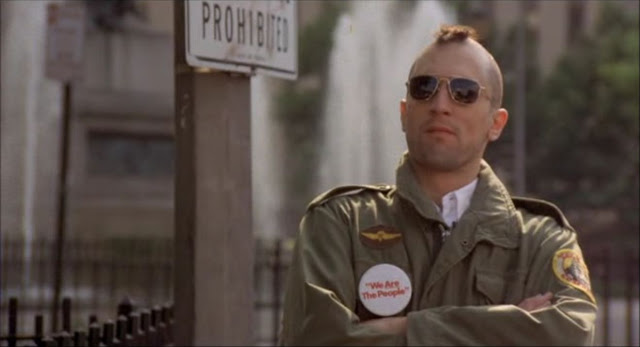


Taxi Driver (1976) is an very artistic film and probably the best character-driven story ever told on film. 5/5 Stars.


Happy watching!


This film is part of my month-long Tribute to Tarantino in honor of his latest film Django Unchained (2012) and his 20-year career. If you've missed any of my reviews so far, be sure to check out his filmography and click on any film you've missed.

The 10 must-see films for Tarantino fans countdown continues tomorrow, so be sure to check back!


Like this blog? You can support it by buying this film through these links:

Thursday, January 24, 2013

His Girl Friday (1940)


Intro
While pouring back through all the Tarantino films recently I realized a couple things:
1) There's not that many of them. I mean he's only one guy and he pretty much only works off of his own material that he wrote... which takes time, and thus this is very understandable.
2) His films make reference other movies constantly. Now call it what you want homage, reference or just plain theft but I'm thinking that a lot of people don't catch the majority of these references to other films because frankly, we don't have the film same exposure as a young Tarantino did going to the grindhouse theater constantly in his youth or working in a video rental store. However, hypothetically with the vastness of the internet and Amazon, Netflix etc. these films should be easier to get a hold of today, if you know what you're looking for that is.

So I figured there's probably more people out there, like me, who crave more Tarantino constantly and I could showcase some films that I'd consider essential viewing for Tarantino fans. And thus the 10 must-see films for Tarantino fans was born. Now let me warn you this is in no way a comprehensive list. There's probably hundreds of films that Tarantino references in his own films, and I found enough films I could write about to probably do this series again but that will have to wait until next time there's another big Tarantino release.

DAY 3: His Girl Friday (1940)

Okay admittedly His Girl Friday might seem like a stretch to try to connect it with Quentin Tarantino. But I didn't want to pick all the typical films you'd expect, and throw a couple, shall we say, "screwballs" in there to show that it wasn't just violent and gory exploitation films that helped form the filmmaker mind of Quentin Tarantino. It's worth noting that Howard Hawks is considered to be an idol to Quentin Tarantino, in fact recently he's been saying that as far as Director's filmographies go you can't top Howard Hawks. He considers the entire filmography of Howard Hawks to be great and would like future generations to look at Tarantino's own films the same way. And so, rather than choose something from Hawks' filmography that you might expect to be linked to Tarantino like the very stylish and (then) violent Scarface (1932) I opted for a less obvious influence, His Girl Friday. Tarantino even wrote in the first page of his script for Pulp Fiction (1994) that the two robbers who decide to rob the diner should talk quickly in a "His Girl Friday fashion" and apparently it's not unique to that film, apparently Tarantino also has shown this film multiple times to different actors on different films to explain that you can speak as fast as you want your dialogue as long as you hit your punchlines. You can find a video of him confessing this here.


AND if all that wasn't enough of a Tarantino-connection for all you naysayers, Tarantino constantly lists this film in his top five films of all time as you can see by these lists compiled by The Quentin Tarantino Archives.


"Walter, you're wonderful, in a loathsome sort of way."

His Girl Friday (1940) a screwball, romantic comedy directed by Howard Hawks and loosely based on the play The Front Page by Ben Hecht and Charles MacArthur. The story follows Walter Burns, fast-talking, do-anything-for a story head editor for a major newspaper who is just finding out that his ex-wife, and former top reporter is getting married to a much simpler man and settling down. Despite Hildy moving on, Walter is not over her yet and is going to do anything he can to try and get her back.


I like the characters in this film, they're all (even down to very minor characters) distinct and yet simple. Smaller characters are placed evenly through the story to service a couple of jokes each and they all are very memorable and funny. The characters with bigger parts each have pretty much one thing on their mind and this serves for even more humor throughout the story.


It does work, but plot of this film is very convoluted and complicated. This is only further muddled by the speed at which everyone talks, which makes it very difficult to follow and can be hard to catch what parts are important during a conversation. This wouldn't matter at all if the story was actually character driven, but no the film is story driven: the characters don't move forward without some prodding from the events of the story. However, said story definitely takes a back seat to the characters it's pretty interesting and unique how they work together like this. Unfortunately this plot is (as I said) treated as a very secondary part riddled with lots coincidences and highly unlikely turns.


The comedy in this film is gold. There's jokes that make me laugh out loud and some of them are admittedly very subtle, but I recommend you see this with an audience and you'll be amazed at how much you'll find yourself actually laughing out loud at. I also really appreciate how many different forms of humor there are, like there's a lot of really funny situational humor in this film that's built just through the way a scene is written or set up. This is a form of creativity that's completely lost on films today. For example a lot of the humor is built around the old-style phones with a separate receiver and there's little gags like Hildy trying to hold two conversations between two phones on different tables and having to run back and forth between them then as one of the conversations gets heated she quickly yells at the other one, "oh I wasn't talking to you!"

I love the dialogue for this film, it's written in the clever, spitfire fast, theatrical way that Hawks was known for but it's also accelerated in this movie because of the fact that they are newspapermen and this not only allows for an interesting medium to quickly release and setup multiple jokes at once, but also great situational humor between a third person trying to keep up in a conversation, and even groups of people talking to different people all in the same frame to convey something that happened off screen.

I firmly believe that this film would not be considered a classic without the two leads. Okay, Cary Grant is always great but I would argue that this early role for him is pretty unique: he's fast, he's rough, he's funny and he's even a touch of the flamboyant. Pretty far off from most of his roles later on in his career. But believe it or not, as much as I like Cary Grant, I almost prefer Rosalind Russell the female protagonist as Hildy in this film. She not only is a really great match for Grant but brings a lot of emotion and soul (and in an very efficient manner too!) to this role that a lesser actor probably would leave out. But both together make such a great team with great chemistry and sex appeal. Like I said, this film wouldn't have been as successful without these two in the lead.


His Girl Friday (1940) is a fast-talking romantic comedy with great characters and a fun story. 4.5/5 Stars.


Happy watching!


This film is part of my month-long Tribute to Tarantino in honor of his latest film Django Unchained (2012) and his 20-year career. If you've missed any of my reviews so far, be sure to check out his filmography and click on any film you've missed.

The 10 must-see films for Tarantino fans countdown continues tomorrow, so be sure to check back!


I'm always happy to recommend copyright-free movies. This film is currently in the public domain, so you can download or stream this film legally and absolutely free right here thanks to the Internet Archive!

Wednesday, January 23, 2013

Hang 'Em High (1968)


Intro
While pouring back through all the Tarantino films recently I realized a couple things:
1) There's not that many of them. I mean he's only one guy and he pretty much only works off of his own material that he wrote... which takes time, and thus this is very understandable.
2) His films make reference other movies constantly. Now call it what you want homage, reference or just plain theft but I'm thinking that a lot of people don't catch the majority of these references to other films because frankly, we don't have the film same exposure as a young Tarantino did going to the grindhouse theater constantly in his youth or working in a video rental store. However, hypothetically with the vastness of the internet and Amazon, Netflix etc. these films should be easier to get a hold of today, if you know what you're looking for that is.

So I figured there's probably more people out there, like me, who crave more Tarantino constantly and I could showcase some films that I'd consider essential viewing for Tarantino fans. And thus the 10 must-see films for Tarantino fans was born. Now let me warn you this is in no way a comprehensive list. There's probably hundreds of films that Tarantino references in his own films, and I found enough films I could write about to probably do this series again but that will have to wait until next time there's another big Tarantino release.

DAY 2: Hang 'Em High (1968)

Hang 'Em High is an American tribute to spaghetti westerns, much like Django Unchained (2012), its a very good revenge story like half of Tarantino's films and the lead character has a "hanging scar" across his neck which I can't help but think inspired Lt. Aldo Raine's scar in Inglourious Basterds (2009).


"You don't remember me, do you? ... When you hang a man, you better look at him."

Hang 'Em High (1968) is a dark revenge western film about justice and the law directed by Ted Post and is the first film from Clint Eastwood's own production company The Malpaso Company. This film was the American attempt at a darker western like those from Italy specifically the films of Sergio Leone. The film follows Jed Cooper a former lawman who is wrongfully lynched by a mob of 9 men, somehow he survives and then he tries to bring the men who hung him to justice.


First off I gotta say how much I like Clint Eastwood in this film, he doesn't do anything too special or unique for this role but he's convincing and you really believe the changes in his views as the lines of justice muddy and right blurs pretty close to wrong. This is his first American film after returning from Italy and doing the Dollars Trilogy for director Sergio Leone, his acting choices are pretty close to the Man with No Name character down to a similar hat and smoking a similar style of cigar but this didn't bother me because of how awesome that character is and he seems to be at least slightly different in this film.

There's a lot of really interesting ideas in this film. I like how at the very beginning the film shows the Marshall who shaved Cooper from the rope, and as he's trying to pick up another criminal the guy escapes and you can visibly see him hesitate, yet all the other criminals locked up are yelling at him to shoot the criminal on the run. It's a pretty interesting scene just because of the irony, and it also sets up the power of a Marshall, which will come into play when Cooper picks up a badge. I like the idea that the hanging is a kind popular event in town which everyone seems to take really lightly and, even though her character wasn't as successful as she could have been, I like the idea of the love interest Rachel Warren checking the faces of all the criminals who come in in attempt to find the man that killed her late husband.

The music is good, it's a bit forceful at times (which can come off as hokey and humorus) but it shows a clear attempt at emulating the spaghetti western style music of Luis Bacalov and Ennio Morricone.


The film has some odd spacing issues, which leads it to feeling really drawn out during some parts then others seem very rushed. Overall I think the film could have been told more effectively in less time.

The romance of this film seems like it was a last minute idea. I don't know if there was cut scenes or what, but basically they meet then immediately they fall in love with this pretty awkward love sequence and they talk about leaving together (which admittedly is an interesting counter point) then he just decides to continue on his revenge path. I would have like to see this romance blossom a little more, because I do think they are an interesting pair together.


The camerawork in this film is very creative and inventive. There's a lot of shots in this film that caught my attention. For example, I love the shot with a bunch of feet dangling which you think are hangmen then the camera pulls up to show these are just people sitting to watch the hanging! I also love a film like this that isn't afraid to pull in really close to the actors during suspenseful moments.

I love the story of this film, along with all its interesting twists and turns. It's such an interesting premise and watching a man get hung in the opening sequence is such a great opening. Furthermore I love how this film dives in to great depth about what is revenge, what is fair justice and the faults of the law and lawmen who must carry it out. I love the couple times this film shows people who are in Cooper's eyes innocent (or at least not worthy of hanging), yet they still hang as a result of the judge's law.


Hang 'Em High (1968) isn't just a stylish attempt at copying the spaghetti westerns it's also a great look into the question of what is justice. 4.5/5 Stars.


Happy watching!


This film is part of my month-long Tribute to Tarantino in honor of his latest film Django Unchained (2012) and his 20-year career. If you've missed any of my reviews so far, be sure to check out his filmography and click on any film you've missed.

The 10 must-see films for Tarantino fans countdown continues tomorrow, so be sure to check back!


Like this blog? You can support it by buying this film through these links:

Tuesday, January 22, 2013

Coffy (1973)


Intro
While pouring back through all the Tarantino films recently I realized a couple things:
1) There's not that many of them. I mean he's only one guy and he pretty much only works off of his own material that he wrote... which takes time, and thus this is very understandable.
2) His films make reference other movies constantly. Now call it what you want homage, reference or just plain theft but I'm thinking that a lot of people don't catch the majority of these references to other films because frankly, we don't have the film same exposure as a young Tarantino did going to the grindhouse theater constantly in his youth or working in a video rental store. However, hypothetically with the vastness of the internet and Amazon, Netflix etc. these films should be easier to get a hold of today, if you know what you're looking for that is.

So I figured there's probably more people out there, like me, who crave more Tarantino constantly and I could showcase some films that I'd consider essential viewing for Tarantino fans. And thus the 10 must-see films for Tarantino fans was born. Now let me warn you this is in no way a comprehensive list. There's probably hundreds of films that Tarantino references in his own films, and I found enough films I could write about to probably do this series again but that will have to wait until next time there's another big Tarantino release.

DAY 1: Coffy (1973)

Coffy is just one of probably a handful of blaxploitation films I could have chose for this list, so why did I choose this one? First off this film stars Pam Grier who Tarantino would much later cast in his film Jackie Brown (1997), reintroduce her to new audiences and essentially restart her career! He would also lift about half of the soundtrack from this film for Jackie Brown. This film is also an early and yet well defined example of, what is blaxploitation. Jack Hill, the director of this film, today is considered one of the greatest exploitation directors and Tarantino himself said that Hill was “The Howard Hawks of exploitation filmmaking." Working with the genres horror, monster movies, sexploitaton and blaxploitation this guy seemed to do it all. And storywise this is a very Tarantino-esque stylishly violent revenge film and much like Django Unchained (2012), this film states that the ultimate evil might not actually be the evil white dudes, but the black dudes who are traitors to their own race.


"Shiiit, come on now!"

Coffy (1973) is a revenge flick written and directed by Jack Hill who is now considered the king of the exploitation genre. Coffy revolves around a black woman who is personally wronged, and sees her friends and loved ones around her constantly wronged by society (and white folks) and one day snaps and goes on a killing revenge trip.


The Music is pretty good in this film, I found it overall pretty hit or miss. But the hits are very good, there's a reason Tarantino used a bunch of it in Jackie Brown! (1997).

Also, (SPOILERS) I enjoyed how her boyfriend ends up being one of Coffy's biggest betrayers.


The acting in this film across the board, is just plain horrible. I wasn’t at all surprised to look up the film afterwards and find that it was a white writer, and with better acting this might've seemed less obvious but, as it is, it sticks out like a sore thumb. The dialogue seems just plain wrong in this film. This is how a white man imitates black people.

Also I'm very disappointed to say that I think Pam Grier was among those bad actors in this film. This is disappointing because I found her acting to be one of the highlights in Jackie Brown and even though that was 20+ years later I hoped to see at least some hint of her great acting in this film. I must admit, she was likable but she has some down-right horrible acting in this film and probably the worse Jamaican accent I've heard in a long time. I also don't think her character was as successful as it could have been. The “it's like I'm dreaming” part of the role hardly even comes across. And I wouldn’t have thought I missed anything because it works as it is, except for the fact that she keeps repeating that she doesn’t really remember doing these acts of violence. This is something I that could have been played WAY up, because it's actually a pretty interesting twist for a character... if it was done right.

This film is basically sexploitation. I think every female actress in this film has her breasts exposed at one time or another, and in the most humorous ways too! There's this fight between a bunch of whores, about halfway into the movie, where boobs are flying, tearing, and popping out left and right! It's actually quite distracting and I found this actually detracts from Coffy, our strong female lead character!

This film is very, very dated, hell it was probably very dated by the 80s! It's downright humorous, which actually pretty much ruins a lot of the moral themes and messages of this film.


The best part of this film is that it follows a strong black female in the lead role. This is something that even today is unfortunately very rare, so I can imagine that back in 1973 this was pretty well unheard of. I also appreciate the fact that she acts (for the most part) like a real person, because it would have been very tempting to make her this macho revenge killer like many other exploitation or even action films.


Coffy (1973) is a stylish (and pretty dated) action film that really wasn’t my cup of tea, but of course I’m not really the target audience at all so I’m not sure if my opinion really has any weight at all on this type of thing. However I would recommend this film if you're looking for an introduction to the blaxploitation genre. 2.5/5 Stars.


Happy watching!


This film is part of my month-long Tribute to Tarantino in honor of his latest film Django Unchained (2012) and his 20-year career. If you've missed any of my reviews so far, be sure to check out his filmography and click on any film you've missed.

The 10 must-see films for Tarantino fans countdown continues tomorrow, so be sure to check back!


Like this blog? You can support it by buying this film through these links:

Monday, January 21, 2013

Quentin Tarantino Filmography


As Writer & Director

0ax) Love Birds in Bondage (1983) [incomplete & lost]

0bx) My Best Friend's Birthday (1985-7) [partially lost, short]

1) Reservoir Dogs (1992)

2) Pulp Fiction (1994)

3) Jackie Brown (1997)

4) Kill Bill: Volume 1 (2003)

5) Kill Bill: Volume 2 (2004)

6) Death Proof (2007)

7) Inglourious Basterds (2009)

8) Django Unchained (2012)


As Writer Only

True Romance (1993)

Natural Born Killers (1994) [credited with story only]

From Dusk Till Dawn (1996)


Collaborations As Director

Four Rooms (1995) [directed segment: The Man From Hollywood]

Sin City (2005) [uncredited, directed segment: The Yellow Bastard]


For more Tarantino goodness be sure to check out my month-long Tribute to Tarantino


Sunday, January 20, 2013

Inglourious Basterds (2009)


"Say 'auf Wiedersehen' to your Nazi balls. "

Inglourious Basterds (2009) is Quentin Tarantino’s unique WWII epic about language and revenge. The film simultaneously follows Lt. Aldo Raine and his group of Nazi hunting Jewish American soldiers called "The Basterds" and Shoshana a French Jew who barely escapes death at the hands of the Nazi SS and sees and opportunity to exact revenge on the National Socialist German Worker's Party.


I really like how Quentin Tarantino, who is known for his dialogue filled with pop culture references, uses pop culture to his advantage in this film. The characters in this film still talk about pop culture in a very Tarantino fashion, but they talk about actors, movies, music and even historical events that were important and hot topics during the time this is supposed to take place. I think this is very interesting and super smart of Tarantino, and not many other writers could actually pull something like this off in a film.

I believe this film is proof Quentin Tarantino finally settling into his own way of storytelling that works for him. This film stops with clever attempts to reinvent how to tell a film story with different formats, instead with this one he kind of makes up his own quirky way to tell a story. The majority of this film is actually straight linear storytelling, but through clever editing (and some other small tricks) Tarantino cuts away in the middle of a scene or action to explain anything further than the linear story can tell. This is evident more than anything in the sudden interrupting flashback/voice over to explain Hugo Stiglitz, the German soldier who went AWOL and killed 13 Nazi officers. It's stylish and still better than random exposition. Kill Bill (2003, 2004) did this also, to a much lesser degree actually (on top of the mixed-up-chapter nonlinear storytelling) in Volume 1 it cut away to set up a lot of the story while the Bride was trying to 'wiggle her big toe' and in Volume 2 it cut away to explain the Pai Mei flashback while she's stuck in a coffin buried alive. And now, retrospectively, I can see Django Unchained (2012) did this for all of its nonlinear cuts, essentially it's just a stylish and very streamlined way to do a flashback and relate relevant exposition or backstory.


My biggest problem with this film is it doesn't feel like one film, instead it feels like a bunch of separate incidents that are loosely connected. The film is essentially telling two different stories moving forward about about the same thing. For my taste I would have liked to see these two stories crossover more, because as it is side characters cross over and (a couple) events cross over from one story to the other but otherwise they're pretty much completely separate stories. There's actually some kind of humor in the fact that they both climb to basically the same climax and never actually cross [though I liked this better in True Romance (1993) where they actually crossed at the end,] and maybe that's what he was going for, but to me this feels incredibly like a serial TV show with a bunch of different characters moving forward and doing different things than a movie that is nicely interconnected.

Also adding to the feel of a TV show, there's too many characters in this film for my taste. This just makes it so that there's a lot of different things going on in this movie that we have to keep track of, I really didn't even appreciate how much is actually really going on in this film until subsequent viewings. Now a majority of the characters come from the fact that he's telling two separate stories, the antagonists (thankfully) carry over in both stories but each has its own set of protagonists and then halfway through we add even more with the advent of "Operation Kino." I've got to ask why the heck there's so many Basterds? It's fine we show 9 Basterds at the beginning of the film (some of which actually never do anything!), and then we add in the German Stiglitz (that's 10) and then we add the two foreign British agents in Operation Kino. I'm not a fan of useless characters or characters who's sole purpose is to die. At least why couldn't we just start with less soldiers in the Basterds to begin with? And all these protagonists are just for one story of the two in this film.

There's also a couple times the film's characters switch language kind of sloppily for convenience more than anything else. The first one is in the opening sequence, and I always find myself asking would a French dairy farmer really actually be proficient at speaking English during this time? This is somewhat excusable because it's in the very beginning of the film (where coincidences slide) and it sets up the language switching and how it will be used for the rest of the film, but I gotta wonder if it would have been easier and more historically possible if they instead switched over to German? Another time that I noticed this is in the pub shootout the German soldier Wilhelm (who is there celebrating the birth of his son) switches to English, this is solely to accommodate the fact that Aldo Raine shouldn't be able to speak anything else, and we wanted him in this scene even though he had another German-speaking Basterd up top. This convenience is pretty well swept under the rug with a "you speak English pretty well for a German soldier." and an "I know... [lets move along.]" Kinda sloppy, not going to lie but hey at least they addressed it?


When I heard the Quentin Tarantino was working on a World War II war film, I was a little disappointed. I personally don't care much for war films and just assumed this film would be a reason-less gorefest (funny how it actually turned out to be one of his tamer films gore-wise). Instead Tarantino decided to shoot the film like a spaghetti western, and I think that is simply genius. I'd never seen anything like that before, and to combine two seemingly completely different genres in one like this is (in my opinion) absolutely brilliant. Think about it, does this film seem like any other war films you've seen before? No. Tarantino used a majority of western music, had the cinematography mimic that of (primarily spaghetti) westerns, and even put in a lot of little nods to westerns story-wise like dynamite and even throwing in a very dramatic Mexican standoff! The result is very smart, interesting and super unique.

This film, like many other Tarantino films, has an absolutely amazing cast. I'm super glad that Tarantino decided to use some foreign actors in the foreign parts because Christoph Waltz really makes this film for me, I just think he's simply amazing as "the Jew hunter" Colonel Hans Landa. But Brad Pitt, Michael Fassbender, Mélanie Laurent, Diane Kruger and Daniel Brühl all have very awesome and memorable roles in this film also, the acting is just great all around.

But my favorite thing about this film is the use of language. Unlike countless American films that use a cheap dubbing of sorts on the script level and subbing in say English in place of German (and maybe adding in an accent) when characters are in other countries, this film doesn't and as a result uses Language to build suspense for the characters in the story. This story takes place in Nazi-occupied France, there's Germans walking around in France and most of our protagonists are American, the film takes this even further by adding in British soldiers and a brief stint of Italian too as the plot develops. The film has a series of sequences (at least 3?) that are interrogations and a character's knowledge and use of language is a key factor in each of these conversations. Also the way that Tarantino masterfully divulges a little information about who knows what in each conversation adds so much suspense not only for the characters but also the viewer who is right there with characters during these sequences, trying to figure out how much each character really knows.


Inglourious Basterds (2009) is something new for Tarantino but also a return to great form too. Highly recommend it. 5/5 Stars.


Happy watching!


Want more Tarantino goodness? Check back all month for my Tribute to Tarantino in honor of his latest film Django Unchained (2012).

Go back to Tarantino's first film with Reservoir Dogs (1992), check out the first script he wrote (but didn't direct) True Romance (1993), The smash hit that really put him on the map Pulp Fiction (1994), another film written by him but in the hands of another director From Dusk till Dawn (1996), his blaxploitation-influenced crime film Jackie Brown (1997, The two part revenge epic Kill Bill: Volume 1 (2003) and Kill Bill: Volume 2 (2004) or his tribute to grindhouse cinmea Death Proof (2007).

Even though I've gone through every film he's directed, I've got more films planned all month so be sure to check back!


Like this blog? You can support it by buying this film (and 8 other Tarantino hits from his 20 year career) in this new set (now on Blu-ray) through these links:

Friday, January 18, 2013

Death Proof (2007)


"You redneck, lunatic bastard!"

Death Proof is yet another tribute to grindhouse cinema from Quentin Tarantino this one however, also is a tribute to the car movies and TV shows from the 70s (you know, the kind that are pretty much completely non-existent these days). This film was released as part of Grindhouse (2007) in US theaters following Robert Rodriguez's zombie film Planet Terror.

Let me start this review by stating right off that there's going to be spoilers with this one, I can't really talk about the film without revealing things that happen that are supposed to be somewhat of a surprise so once again if you want the full first time experience of Death Proof stop reading now, and go rent the film. Death Proof is about Stuntman Mike a sadistic former stuntman who gets his jollies by killing women in cars at fast speeds.

[This review will focus on the 114 minute, theatrical cut of the film]


Turns out Eli Roth makes a very convincing creeper. Hmmm.


One major thing that doesn't work in this film for me is the structure. I applaud Tarantino for trying to make different films and always push the boundaries on how a story or a film can be told, but there's a good reason why everyone uses the three-act structure... because it works. This film is a two-act story (you know like a play?) and I don't think this is inherently the only problem with the film, I think that this may have worked if we didn't spend so much time trying to get to know these characters and then kill them all off at the halfway point. Yes the only character who carries over in the two parts is Stuntman Mike, the antagonist. While this is interesting and a nice thing to try, I just don't think it's successful. I really think he's trying to do too much with it: not only is he trying to split the film right down the middle between a "successful kill" for Stuntman Mike and an {everything goes wrong kill" for Stuntman Mike, but he's also trying to surprise you with the fact that he kills the protagonists at the halfway point. While yes, this worked in Hitchcock's Psycho (1960), I'm sorry you did not emulate it well.

The other major problem with this film is the transparency of the writing. Now don't get me wrong, I'm a big fan of Tarantino films, and an even bigger fan of his writing and dialogue. This film however, did not do it for me. This film found the line of how much "Tarantino talk" I can really take, because frankly the first half is actually just pretty damn boring. The majority of the first half is four girls talking about (as far as the story is concerned) pointless stuff. AND they all sound like Tarantino [something I had had a problem with the way Alabama spoke in True Romance (1993)]. I just don't think that Tarantino must have many female friends because I don't know any females who talk like the girls in this film. The part where they're talking about how far one of them has gone with her boyfriend is especially cringe worthy, and awkwardly written and there's this extra long take of this film is circling a table with them all talking, that honestly I could have completely done without. It drags on for WAY too long, and there is next to nothing important gained from this conversation but yet it stayed in the film for the director's flair. This is a classic example of a director not knowing how to cut his own fat.

Oh and atrocious Quentin Tarantino cameo alert! Dude seriously, stop giving yourself speaking roles.


One good thing about this film is the Stuntman Mike character played by Kurt Russell. I had no idea that Kurt Russell could be SO creepy. His character is very well reasoned, he's interesting and also somewhat strangely funny. My only problem with Stuntman Mike is that Kurt Russell plays it almost exactly like Bill from Kill Bill (2004). I don't know if this is just the way it's written or if this was Tarantino's direction, but I can't listen to Stuntman Mike and not hear Bill, I'm gonna chalk this one up to the transparency of the writing again.

And basically the only reason I'd recommend people see this film is the car chase at the end. This is without a doubt the greatest car chase in the last 30 years, if not, one of the greatest ever filmed! This was filmed at full speed, without constantly cutting between different cameras, with real stunts and it really feels like a breath of fresh air compared to how action and car chases are filmed these days.


Death Proof (2007) is easily the low point of Quentin Tarantino's career, so much that I'd say it's pretty much completely un-noteworthy with the exception of the amazing car chase hiding out at the end of the film. 2/5 Stars.


Happy watching!


Want more Tarantino goodness? Check back all month for my Tribute to Tarantino in honor of his latest film Django Unchained (2012).

Go back to Tarantino's first film with Reservoir Dogs (1992), check out the first script he wrote (but didn't direct) True Romance (1993), The smash hit that really put him on the map Pulp Fiction (1994), another film written by him but in the hands of another director From Dusk till Dawn (1996), his blaxploitation-influenced crime film Jackie Brown (1997) or the revenge epic split between two volumes Kill Bill: Volume 1 (2003)and Kill Bill: Volume 2 (2004). I got films planned all month, so be sure to check back!


Like this blog? You can support it by buying this film (and 8 other Tarantino hits from his 20 year career) in this new set (now on Blu-ray) through these links:

Tuesday, January 15, 2013

Kill Bill: Volume 2 (2004)


"That woman deserves her revenge... and we deserve to die."

Kill Bill is Quentin Tarantino’s first [well second if you count From Dusk till Dawn (1996)] tribute to the films of a “grindhouse” cinema. This film is a revenge story that’s jam-packed full of references to different films from all across the scope of cinema: different genres, cultures and styles. Kill Bill: Volume 2 (2004) continues the story of the Bride on her quest to, well, kill... Bill. Where Volume 1 is questions, Volume 2 is fortunately answers.


If you remember (all the way back to yesterday) my biggest problem with Kill Bill: Volume 1 (2003) is that its story doesn't work on its own as a film. Well Volume 2 totally fixed that. This film starts by introducing a frame story of the Bride on her final drive to Bill's home. This changes the story so that the bride is narrating and explaining everything she's been through as she's on her way to her anticipated final destination. This makes me question why we didn't start with a frame in the beginning of the first film, then we could have cut back to it for a cliffhanger at the ending, but who am I to tell Tarantino how to order his films right? Maybe the frame opening to this film is the actual opening to the first film if we saw both films back to back? *cough*don't hold your breath*cough* Well whatever the reason, this makes this film work right from the beginning better than the way the last one ended. (Yay!)

I also want to mention how much I love the Bill character in this film. In the hands of most other directors, he would have stayed an aloof mystery as he was in the first film, but nope instead the character comes in (really not until) the ending and becomes one of the coolest and most interesting characters of the entire movie(s). Now I'm sure some of this coolness is thanks impart to the awesomeness of the late David Caradine, but still this should be proof that you can have an awesome antagonist even with only a little actual screen time.

Volume 1 has a great soundtrack, but personally I really like Volume 2's better. The Spanish style guitar, (some of which provided by director Robert Rodriguez) really is the cherry on top for this film. And the credit sequence is just plain cool. It' really makes me wish these were released together as one film, because no matter how hard your butt hurts that credit sequence with the full curtain call and the amazing music rolls, would make it totally worth it.


I admit this is nitpicky, but I noticed that if you watch this film on it's own the Pai Mei flashback really sticks out because the first film is very decidedly "asian" in feel, and this film is much more "western," thanks in part, mostly to the settings (Texas, California desert, etc.) The Pai Mei scenes will work as a nice connector between the otherwise very different "in feel" films but as it is now it kinda seems out of place. Don't get me wrong, I love the Pai Mei scenes, and I think they're introduced in a really, really great way (during the buried alive sequence) just an observation.


I liked the fight scenes in the first film, this film somehow manages to plus them! As would be natural, in one film the fight scenes in the first half pale in comparison to the second half, the fights in this film are far more interesting, clever and unique in my opinion. I love how the Pai Mei sequence is a direct throwback to Shaw Brothers kung-fu films, and I love how the fight with Elle in Budd's trailer is very "Jackie Chan-esque" in that they use a lot of the surroundings in the trailer to fight and I love the gag in the first part where Elle can't even pull out her Hanzo sword without hitting a trailer wall. And I know its short and abrupt but the climactic fight with Bill is really awesome to me, I love how they talk for ever and ever and then it's over in almost a flash. Very cool.

I think the "buried alive" sequence is possibly the most suspenseful piece of film in the last decade (or two!) I absolutely love how it goes completely dark for quite a while and all you can hear is the sounds of being buried alive, and then when she turns on the flashlight underground, the frame is suddenly black and white. Super clever, stylish and effective all in one!

But what I really love in this film is the story. Everything I thought was lacking in the first, improves tenfold in this. I love how the film basically builds its own modern mythology with these characters (specifically the Bride) and I love how the story pays off in the end. I really like how the reveal (not a twist because the audience already knew) to the Bride that her daughter is still alive almost completely unhinges the story we were following, and suddenly her revenge takes a backseat to her daughter. Then she goes to talk to Bill and realizes he's still kind of an a-hole and that he does in fact deserve to die for what he did, still.


Kill Bill: Volume 2 (2004) is everything I was missing in Volume 1, and then some. 5/5 Stars.


Happy watching!


Check out this original minimalist poster design I did for this film, click through to buy prints/posters etc. OR check out other movie posters I designed here. :)

Want more Tarantino goodness? Check back all month for my Tribute to Tarantino in honor of his latest film Django Unchained (2012).

Go back to Tarantino's first film with Reservoir Dogs (1992), check out the first script he wrote (but didn't direct) True Romance (1993), The smash hit that really put him on the map Pulp Fiction (1994), another film written by him but in the hands of another director From Dusk till Dawn (1996), his blaxploitation-influenced crime film Jackie Brown (1997) or the first half of this story Kill Bill: Volume 1 (2003). I got films planned all month, so be sure to check back!


Like this blog? You can support it by buying this film (and 8 other Tarantino hits from his 20 year career) in this new set (now on Blu-ray) through these links: